
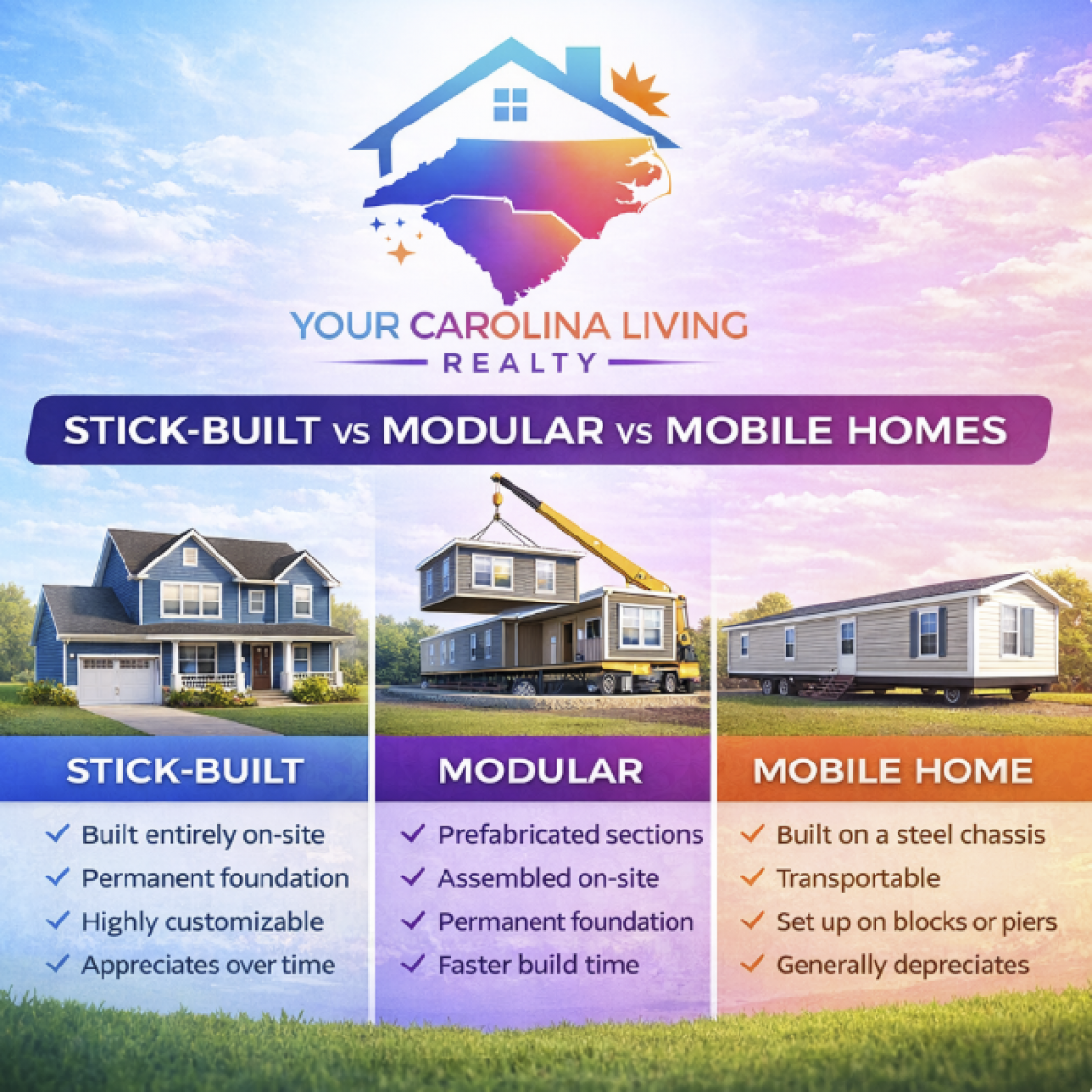
Stick-Built vs. Modular vs. Mobile Homes
When it comes to building or buying a home, one size definitely does not fit all. Today’s buyers and investors have more options than ever before. Each with its own benefits, costs, and long-term considerations. At Your Carolina Living, my goal is to help you make informed decisions that align with your lifestyle, budget, and long-term wealth goals.
Let’s break down the three most common residential construction types: stick-built homes, modular homes, and mobile (manufactured) homes.
Stick-Built Homes (Site-Built Homes)
What is a stick-built home? A stick-built home is constructed entirely on-site, piece by piece, using traditional building materials like lumber, concrete, and brick. This is the most common type of home construction in the Carolinas.
Advantages
Customization: Floor plans, layouts, finishes, and upgrades can be fully customized.
Strong resale value: Often appreciated the most over time.
Financing options: Widely accepted by lenders; qualifies for conventional, FHA, VA, and USDA loans.
Zoning friendly: Accepted in nearly all residential zoning areas.
Disadvantages
Longer build time: Weather delays and labor shortages can extend timelines.
Higher cost: Labor and material costs are typically higher.
Construction exposure: Materials are exposed to weather during the build.
Stick-Build Homes are best for buyers who want full customization, long-term appreciation, and traditional neighborhood settings.
Modular Homes
What is a modular home? A modular home is built in sections (modules) inside a climate-controlled factory and then transported to the home site for assembly on a permanent foundation.
Advantages
Faster build time: Factory construction reduces delays.
Cost-effective: Often less expensive than stick-built homes.
High quality control: Built indoors, protected from weather damage.
Appraises like site-built homes: Considered real property once placed on a permanent foundation.
Disadvantages
Limited customization: Fewer design changes once production begins.
Transportation logistics: Requires access to the site for large modules.
Zoning restrictions: Some communities may limit modular homes.
Modular Homes are best for buyers seeking quality construction, faster timelines, and cost savings without sacrificing long-term value.
Mobile (Manufactured) Homes
What is a mobile or manufactured home?Manufactured homes are built entirely in a factory and transported to the site as a single unit or multiple sections. Homes built after 1976 must meet HUD standards.
Advantages
Most affordable option: Lower purchase and installation costs.
Quick placement: Can be move-in ready in a short timeframe.
Ideal for landowners: Works well for rural or private land settings.
Disadvantages
Depreciation risk: Often loses value over time, especially if not on owned land.
Financing challenges: Fewer lenders; higher interest rates.
Zoning and community restrictions: Not allowed in some areas.
Perception issues: Still misunderstood despite modern upgrades.
Mobile Homes are best for Buyers prioritizing affordability, flexibility, or short-term housing solutions.
Quick Comparison at a Glance
Feature | Stick-Built | Modular | Mobile |
Built Location | On-site | Factory + site | Factory |
Build Time | Longest | Moderate | Fastest |
Cost | Highest | Mid-range | Lowest |
Customization | High | Moderate | Limited |
Financing | Easy | Easy | Limited |
Appreciation | Strong | Strong | Varies |
Which Option Is Right for You?
The “best” home isn’t just about price, it’s about long-term goals, zoning, financing, and lifestyle needs. Whether you’re a first-time buyer, investor, or landowner exploring development opportunities, understanding these differences is key to building wealth through real estate.
At Your Carolina Living, I help clients across North and South Carolina evaluate land, zoning, financing, and construction options—so you can choose the path that works best for you.
📩 Thinking about building or buying?
Let’s talk through your options and create a strategy that fits your goals.
